What is second fix? First fix and second fix explained, and what the materials cost
· 9 min read
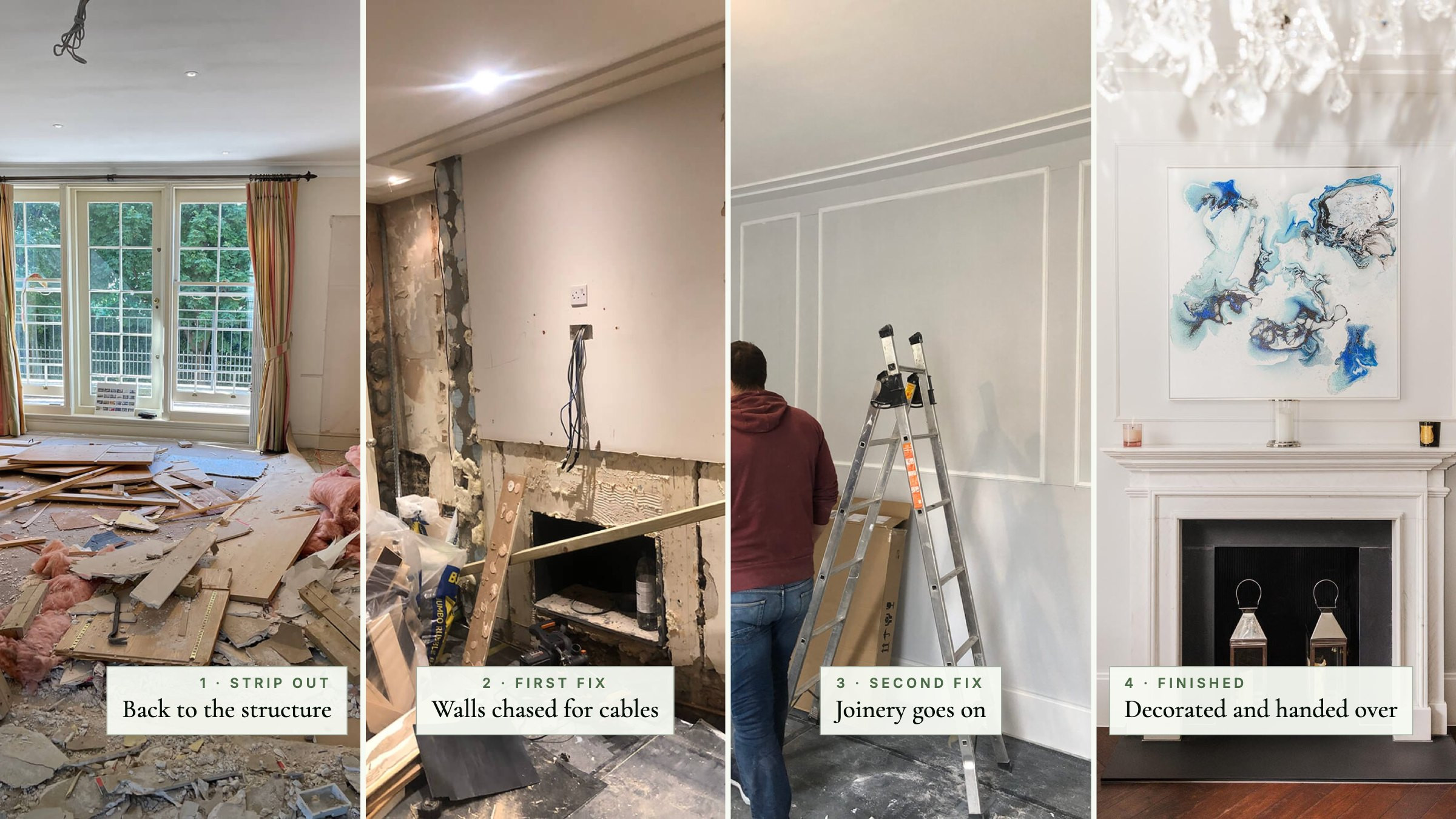
Second fix is the finishing stage of a building or renovation project: everything fitted after the walls are plastered. First fix is the work that disappears into the walls, floors and ceilings before the plaster goes on: cables and back boxes, pipes, and the timber that frames the rooms. Second fix is what you see and use: the floors, skirting and architraves, internal doors, sockets, switches and lights, radiators, paint, the kitchen and the bathrooms.
For a typical Victorian terrace in London, about 100 m² with three bedrooms, the materials to finish every room, windows aside, come to £18,500 to £35,400 at a Standard finish: supply only, including VAT, before delivery, at prices checked in September 2026. Labour and fitting are not in that figure. Our free second fix calculator works out the same schedule of materials for your own home.
First fix and second fix: what is the difference?
Most trades visit a room twice, once on each side of the plastering.
- First fix: the electrician runs the cables and fixes the back boxes; the plumber runs the water, heating and waste pipes, leaving pipe tails where each radiator, basin and WC will go; the carpenter builds the stud walls and fits the door linings.
- Plastering: the walls and ceilings are plastered or dry lined over the first fix. It is neither fix, but the line between them.
- Second fix: the same trades come back. The electrician fits the faceplates, lights and extract fans, the plumber connects the radiators and sanitaryware, and the carpenter hangs the doors and fits the skirting and architraves.
Strictly, the terms belong to those three trades, but in a renovation they often cover everything that finishes a room, as they do in our calculator. A rough test: if it is buried in a wall, floor or ceiling, it is first fix; if you can touch it in the finished room, it is second fix. There is no standard third fix: if a quote lists one, ask what it covers.
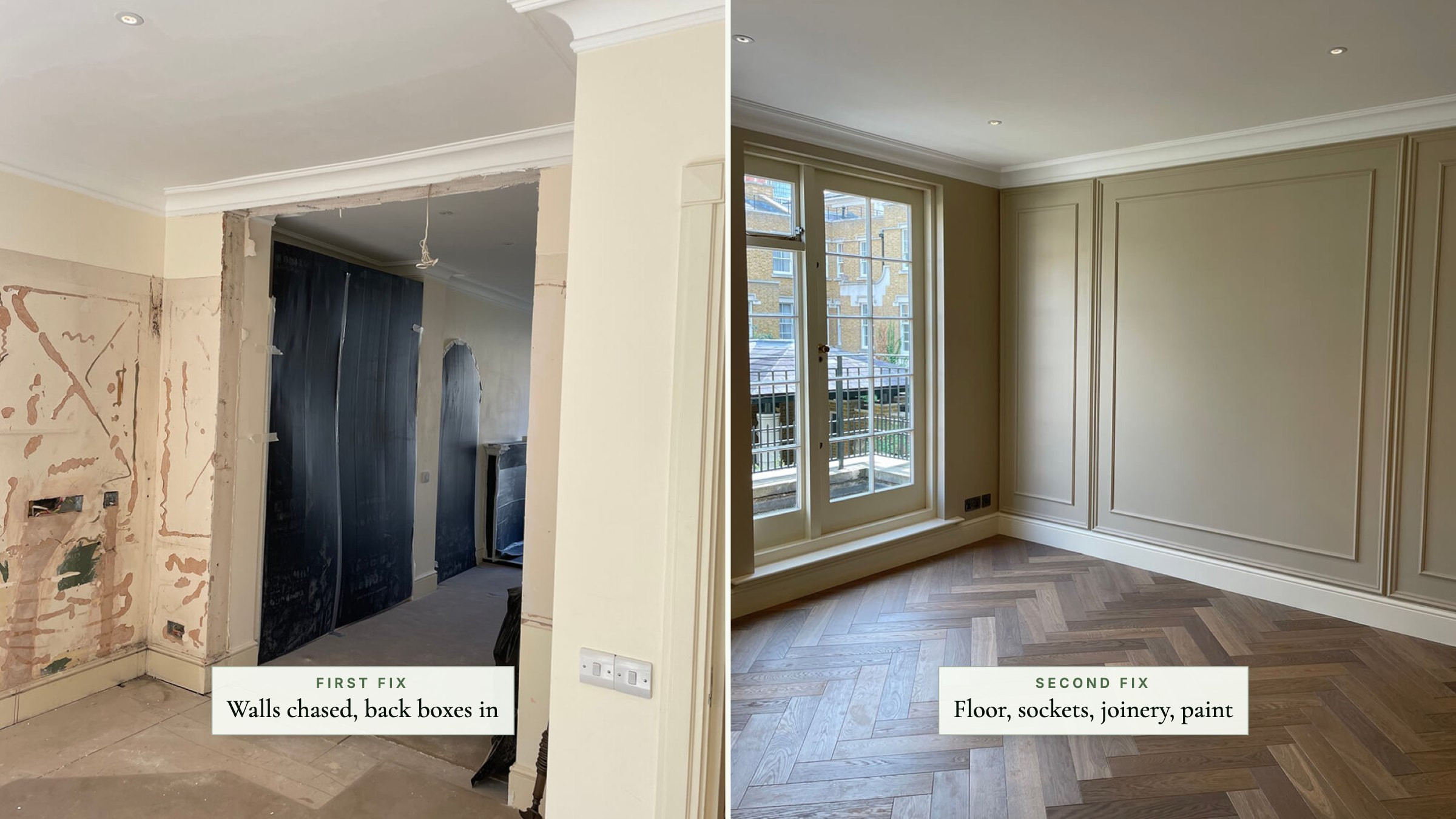
The photos at the top are from Balniel Gate, our four month design and build in Pimlico: first fix on the left, cables and back boxes in, and a finished room on the right.
What does second fix include?
Our calculator prices second fix as nine trades:
- Flooring: the floor finish, underlay and trims, and carpet on the stairs.
- Skirting and architraves: the boards at the foot of the walls and the mouldings round each door.
- Internal doors: each a complete set, with lining, hinges, latch and handles. Our coving, cornice, skirting and doors guide covers the styles.
- Radiators: one per bedroom, living room, hall, landing and kitchen, with valves; towel rails come with the bathrooms.
- Sockets, switches and lights: faceplates, dimmers, downlights, pendants, extract fans, and the kitchen's cooker switch and fused spurs.
- Decoration: a mist coat on new plaster, emulsion, woodwork paint and sundries.
- Windows and glazing: windows with their boards, and any sliding or bifold doors; a separate choice, as new windows usually go in before the plaster.
- Kitchen: units, worktops, five appliances, sink and tap. See what a new kitchen costs in London.
- Bathrooms: WC, basin and vanity, bath or shower, taps, towel rail, tiles and tanking, and any cloakroom WC. See what a bathroom renovation costs in London.
When does second fix happen in a renovation?
Second fix begins once the plaster is dry. On a typical refurbishment the order runs:
- Strip out, and any structural work.
- First fix: electrics, plumbing, heating and carpentry. New windows often go in now.
- Plastering or dry lining, drying out, then a mist coat: a thinned first coat of paint that seals the new plaster.
- Second fix carpentry, the kitchen, and the bathroom tiling and fittings. Hard floors usually go down before new skirting, which hides their edge.
- Second fix electrics and plumbing: faceplates, lights, radiators and sanitaryware.
- Decoration, then carpet, which goes down last.
The order varies, and our guide to the house renovation order of works takes it stage by stage. The second fix is best decided before the first fix starts: a wall hung WC needs its frame in the wall, a concealed shower its valve, and every socket, light and radiator its cable or pipe in the right place. Deciding early also turns a quote's allowances into prices: see keeping a renovation on budget. On Ellerby Street, our six month design and build of a Victorian house in Fulham, the second fix fittings were chosen in the interior design package, before construction.
What do the finish levels mean?
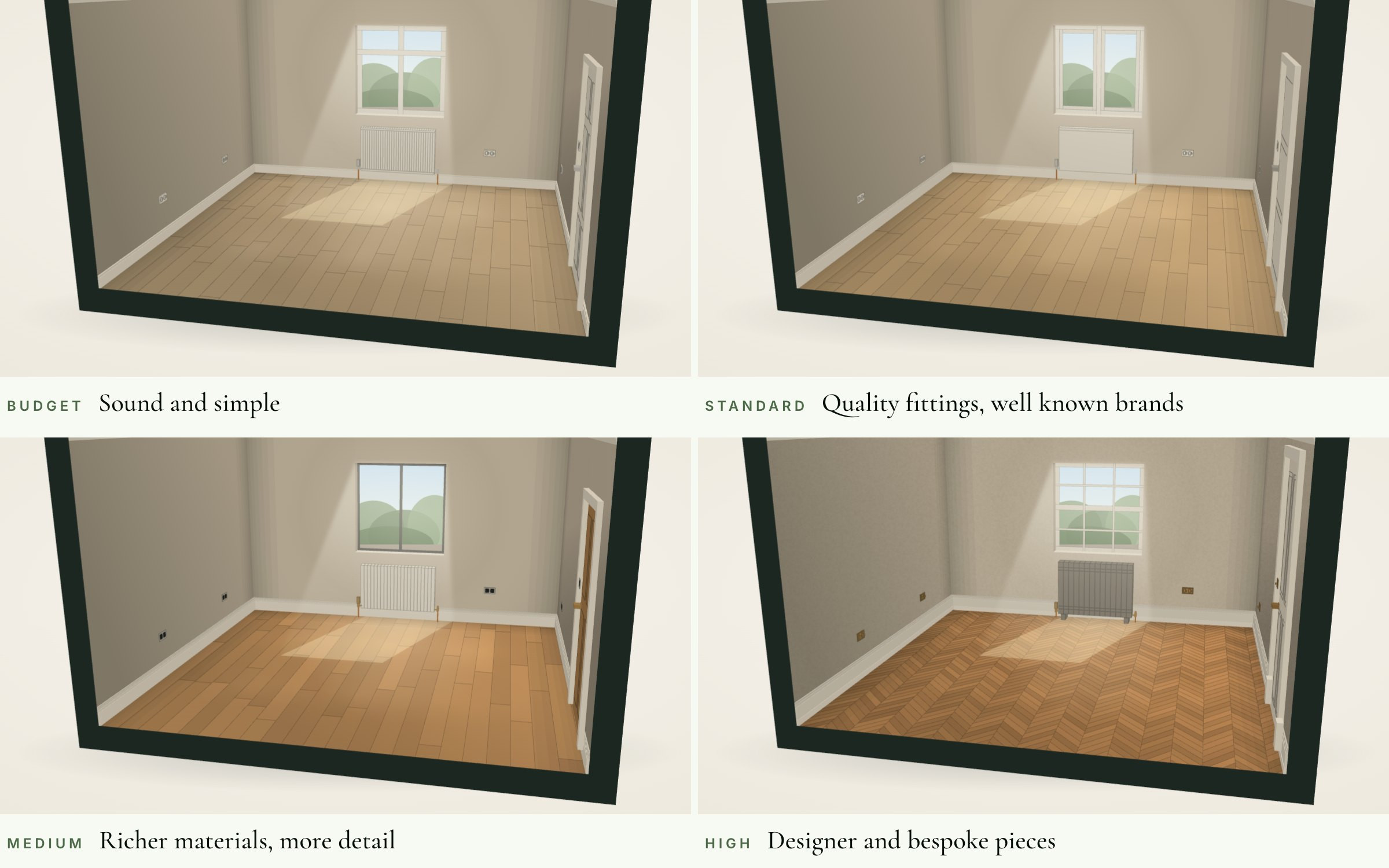
Every trade is priced at one of four levels, which change what you buy, not the size of the job.
- Budget, sound and simple, trade ranges: laminate, white moulded panel doors, white steel double panel radiators, white plastic sockets from MK, BG or Click Mode, and trade vinyl matt paint.
- Standard, quality fittings, well known brands: luxury vinyl or Quick-Step laminate, solid core shaker doors, radiators from Stelrad or Myson, slimline sockets such as BG Evolve, and Dulux Trade Diamond Matt.
- Medium, richer materials, more detail: engineered oak, prefinished oak doors with solid brass levers, painted steel 3 column radiators, screwless metal plates, and Little Greene or Mylands paint.
- High, designer and bespoke pieces: engineered oak in wide plank or herringbone from makers such as Ted Todd or Kährs, made to measure doors with Buster + Punch or Croft ironmongery, cast iron radiators, solid metal plates with toggle switches, and Farrow & Ball.
Each level is a band, not one price. The best case buys every item at the low end of real products that fit the level, at UK suppliers; the worst case at the high end, plus 10% for rising prices and whole packs, tins and lengths. The worst case is not a ceiling, and any trade can take its own level.
What do second fix materials cost for a typical London home?
The calculator's typical Victorian or Edwardian terraced house is about 100 m² over two floors, with three bedrooms, two living rooms, a separate kitchen, one bathroom, a cloakroom WC and period ceilings. For a full strip out, windows aside, its materials come to:
- Budget: £9,700 to £18,800
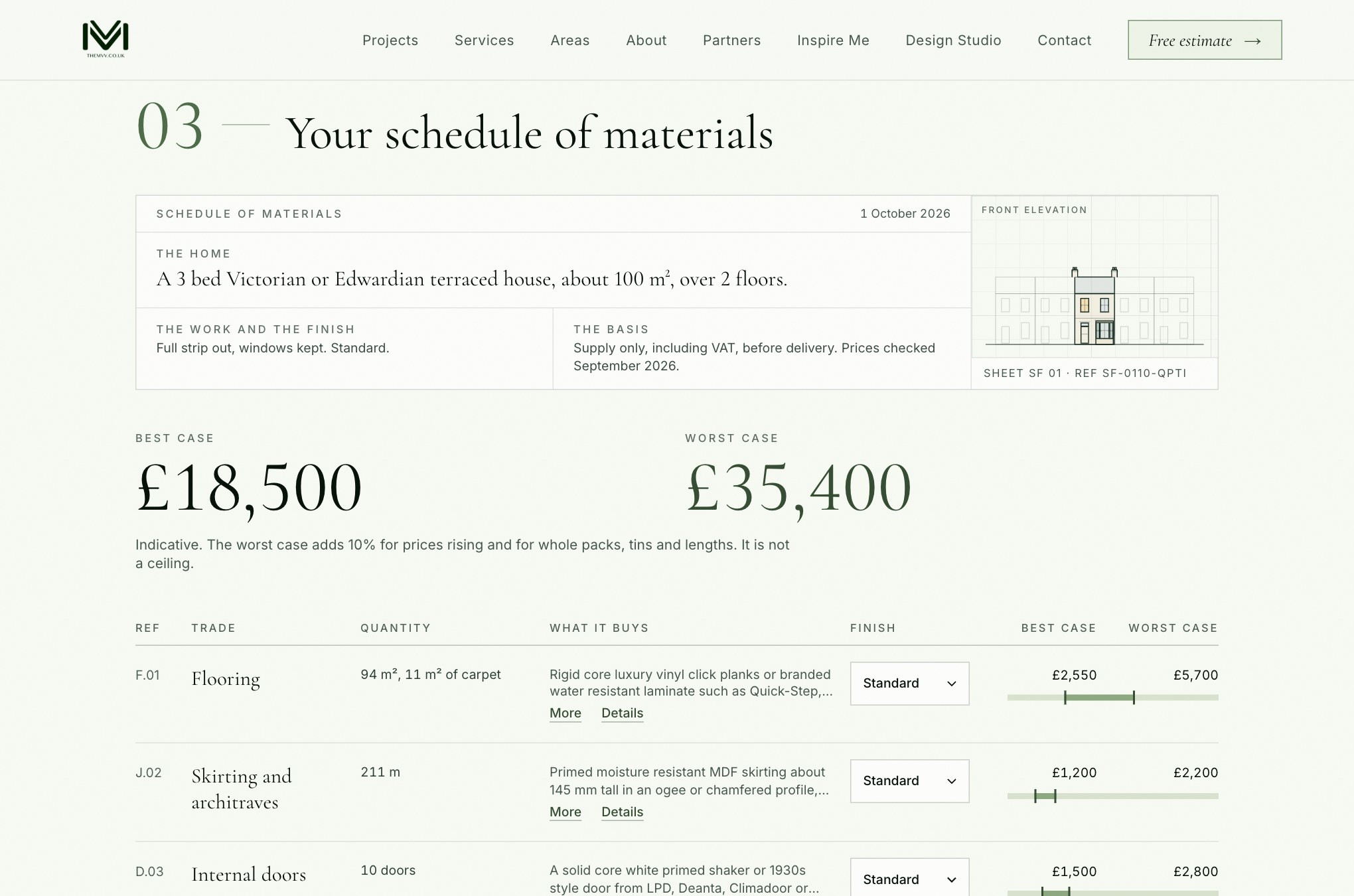
- Standard: £18,500 to £35,400
- Medium: £31,900 to £65,600
- High: £71,100 to £154,800
Each runs from best case to worst case, supply only, including VAT, before delivery, at prices checked in September 2026. At Standard, the schedule reads:
- Flooring, 94 m² of floor and 11 m² of stair carpet: £2,550 to £5,700
- Skirting and architraves, 211 m: £1,200 to £2,200
- Internal doors, 10 sets: £1,500 to £2,800
- Radiators, 8 with valves: £1,300 to £3,250
- Sockets, switches and lights, including 29 double sockets, 18 downlights and 5 pendants: £970 to £2,100
- Decoration, 345 m² of walls and ceilings: £1,200 to £1,950
- Kitchen: £5,450 to £9,450
- Bathroom and cloakroom WC: £4,300 to £7,900
Lines are rounded. The kitchen and bathrooms are about half the total at every level, a little more at High. Windows are a separate choice: nine new windows with their boards add £3,100 to £7,200 at Standard.
These are materials alone. For fitted costs, building work included, see our London cost guides to a flat renovation, a Victorian terrace renovation, a new kitchen and a bathroom renovation; for your own home's building work, our free estimate gives an indicative range.
What moves the price?
After the level, four things move the figure most:
- The kitchen and bathrooms: the kitchen alone is £5,450 to £9,450 at Standard and £25,700 to £58,100 at High. A second bathroom adds £2,900 to £5,200 at Standard.
- The rooms: each bedroom brings a door, a radiator, a pendant, sockets and skirting. With four bedrooms, about 120 m² and two bathrooms as the calculator sizes it, the terrace comes to £23,300 to £44,700 at Standard.
- The floors: in a house of three or more floors, the doors onto the halls and landings usually need to be fire doors under the Building Regulations. A planned 25 m² loft conversion, with a bedroom and a bathroom more, takes the terrace to £24,700 to £46,900 at Standard, with 9 of its 12 doors priced as FD30 fire door sets.
- An extension: finishing a 20 m² extension planned at the back, with its open plan kitchen and extra living space, takes Standard to £19,600 to £37,800.
Mixing levels spends where it shows: at Standard with a Medium kitchen the terrace comes to £21,900 to £44,100, and with a High kitchen £38,700 to £84,000.
What is not included?
The calculator is a benchmark of the main materials a second fix takes, whoever does the work, not a quote from MVV or anyone else. It leaves out:
- Labour and fitting, the first fix wiring and plumbing, the plastering, structural work and professional fees.
- Delivery: every price is before delivery.
- Items not yet priced, such as a kitchen splashback, tile backer board, floor levelling and carpet grippers.
- Smoke and heat alarms, a consumer unit, outside lights, fitted wardrobes, external doors, rooflights, fireplaces, boilers and furniture, and designer pieces above the High band.
Stone worktops are the one exception to supply only: at Medium and High they are sold templated and fitted, so the fitting is in the price. For a whole refurbishment, building work included, see our guide to house refurbishment costs in London.
How do you use the second fix calculator?
The second fix calculator is free, sits in our Design Studio and asks for no sign-up. It works in three steps:
- Your home: choose the kind of home and when it was built. It fills in a typical size, bedrooms, bathrooms and floors; change anything that differs, and add an extension, built or planned.
- The work and the finish: tick the trades you are renewing, or Everything for a full strip out, then choose Budget, Standard, Medium or High.
- Your schedule: every trade with its quantity, what it buys, brands named, and its best case to worst case. Give any trade its own level, then print it, save it as a PDF or copy a link that holds your answers and nothing personal.
Take the schedule to a designer, builder or supplier as a checklist, so every price covers the same things. For the building work, our free estimate gives an indicative range; a firm price comes from a quotation, once the property has been seen. For one team from first fix to the last coat of paint, see our property refurbishments and design and build services.
Good to know
Frequently asked questions
- What is the difference between first fix, second fix and third fix?
- First fix is the work done before the walls are plastered: the electrician's cables and back boxes, the plumber's water, heating and waste pipes, and the carpenter's stud walls and door linings. Second fix is everything fitted after the plaster: faceplates and light fittings, radiators and sanitaryware, doors, skirting and architraves, and in a renovation often the floors, the kitchen, the bathrooms and the decoration too. Plastering itself is neither, but the line between them. Third fix is not a standard stage: some electricians use it for connecting the cables to the sockets, switches and consumer unit, others for whatever goes in after the decoration, so ask what a quote means by it.
- What do second fix electrics, plumbing and carpentry include?
- Second fix electrics are the sockets, switches, dimmers, light fittings and extract fans, and the kitchen's cooker switch and fused spurs, fitted to the cables and back boxes left at first fix. Second fix plumbing connects the radiators, basins, WCs, baths, showers and taps to the pipe tails. Second fix carpentry hangs the internal doors with their hinges and handles and fits the skirting and architraves.
- Can second fix electrics go in before plastering?
- No. Second fix electrics are the sockets, switches, light fittings and extract fans, fitted to the back boxes and cables the first fix left in the walls and ceilings, and they need the finished plaster to sit on: fitted before it, they would be buried or spoiled. While the plasterer works, the back boxes wait in the wall with their cable tails. The electrician comes back once the plaster is dry, often after the mist coat, fits the plates and fittings, then tests the installation and certifies it.
- How much do second fix electrics cost?
- For the materials, our free second fix calculator counts 29 double sockets, 12 switches, 2 dimmers, a cooker switch, 3 fused spurs, 18 downlights, 5 pendants and 2 extract fans in a typical three bed Victorian terrace of about 100 m². They come to £420 to £860 at Budget, £970 to £2,100 at Standard, £1,600 to £4,000 at Medium and £4,350 to £11,050 at High: supply only, including VAT, before delivery, at prices checked in September 2026. A consumer unit and smoke alarms are not in that figure. Labour is not included either: it is the electrician's, and is usually priced with the first fix, as one job. For scale, a full rewire of a large London house of about 165 m² priced at around £40,000 ex VAT on our estimator in September 2026, indicative.
- How much do second fix materials cost for a house in London?
- For a typical Victorian terrace of about 100 m², with three bedrooms, one bathroom and a cloakroom WC, the materials for every trade but the windows come to £9,700 to £18,800 at Budget, £18,500 to £35,400 at Standard, £31,900 to £65,600 at Medium and £71,100 to £154,800 at High. These figures, from MVV's free second fix calculator, are supply only, including VAT, before delivery, at prices checked in September 2026. Labour and fitting are not included.