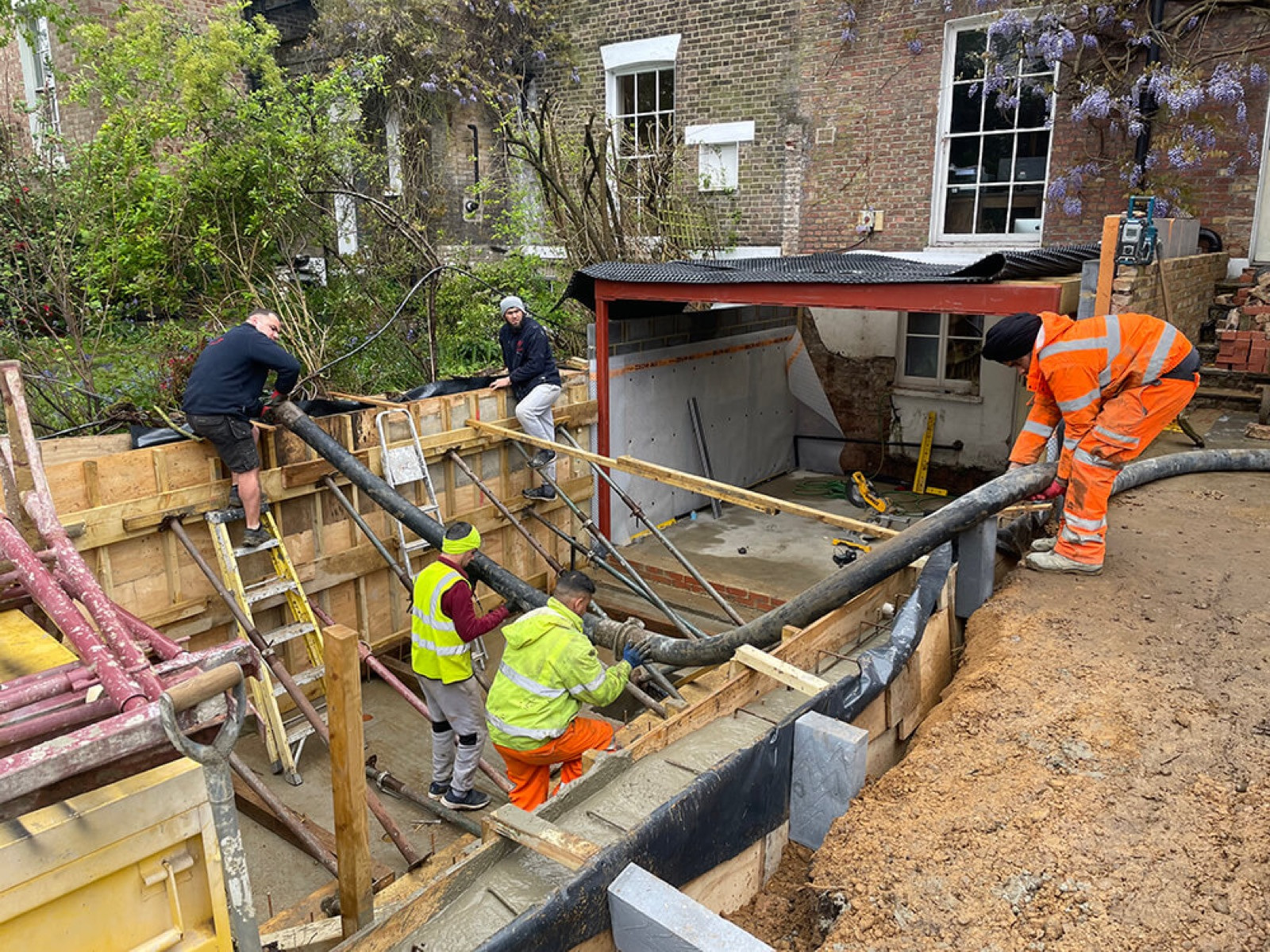
New Build or Refurbishment in London: Which Makes More Financial Sense?
· 7 min read

In London, the choice between new build and refurbishment turns as much on tax, planning and levies as on build cost. For a developer building homes to sell, a genuine new build has the VAT advantage, because the construction and the first sale can both be zero-rated. For an owner-occupier, a genuine rebuild is zero-rated too, but planning and demolition rules usually favour refurbishing, often with an extension.
Refurbishment normally carries VAT at 20 percent, but it avoids a new planning case, the demolition steps and usually the Community Infrastructure Levy (CIL). Here is how each lever works, as of September 2026.
Knock down and rebuild, refurbish, or extend?
Three routes suit most London houses:
- Knock down and rebuild: zero-rated for VAT if the old building is demolished completely, but it needs planning permission, a demolition step, possibly CIL, and, from March 2027, the Future Homes Standard.
- Refurbish: VAT at 20 percent unless a reduced rate applies, usually no planning permission, no CIL, and favoured by carbon policy.
- Refurbish and extend: VAT at 20 percent and permission or permitted development for the extension, but the shell stays. An extension under 100 m² pays no CIL.
From projects we priced in August 2026, an extension plus refurbishment of around 150 m² overall came to £210,000 to £250,000 ex VAT, indicative; our house extension cost guide has more. At Woodside in Wimbledon, MVV converted two flats into a single high-spec dwelling, adding a loft conversion with three new bedrooms and two bathrooms.

Is a new build zero-rated for VAT?
As HMRC's VAT Notice 708 explains, a new dwelling built by a VAT-registered builder is zero-rated, but only if the old building is demolished completely to ground level first:
- What may stay: cellars, basements, the ground slab and party walls with neighbouring houses that are staying.
- Facades: one facade, or two on a corner site, may be kept only where the planning consent requires it.
- The partial demolition trap: a house substantially but not fully demolished, for example under a permission to alter and extend it, then rebuilt around what remains, is not zero-rated.
- Timing and fees: demolition before planning permission, and separately appointed architects, are standard-rated; under a design and build contract the whole supply can be zero-rated.
Someone building a new home to live in, or converting a non-residential building into one, can reclaim eligible VAT through HMRC's DIY housebuilders scheme within six months of completion. Homes built to sell or let, and occupied flats combined into one house, do not qualify.
When is renovation VAT 5 percent?
Two main routes carry VAT at 5 percent:
- Homes empty for two years: renovating a home nobody lived in during the two years before work starts.
- Conversions that change the number of dwellings: an office turned into homes, a house split into flats, or two flats made into one house. Work unrelated to the change stays at 20 percent.
As of September 2026, installing energy-saving materials in a home, such as insulation, heat pumps and solar panels, is zero-rated until 31 March 2027 and 5 percent from 1 April 2027.
New build vs refurbishment for property developers
A developer's first sale or long lease of a new dwelling it has built can be zero-rated, which lets it recover the VAT on the scheme's costs, such as professional and selling fees. Homes converted from non-residential buildings can be sold zero-rated too. Other home sales are normally exempt, so VAT spent refurbishing a house for sale stays a cost.
The Building Safety Levy applies to building control applications made on or after 1 October 2026 for schemes of 10 or more new dwellings under the planning permission, with social housing and some other uses exempt. Offices converted into ten or more flats pay it; a single replacement house does not. Our property development service tests a scheme's viability before you proceed.
Do you need planning permission to knock down a house in London?
A replacement house needs planning permission in its own right, while work affecting only the interior of a house generally does not.
Outside conservation areas, demolishing a house is usually permitted development, but you must first apply to the council to decide whether it needs to approve the method of demolition and how the site will be restored. Work can start once the council says approval is not needed, once it approves, or after 28 days without a decision. An Article 4 direction can remove this right.
In a conservation area, demolishing an unlisted building of more than 115 cubic metres needs planning permission, and demolishing without it is an offence. A listed building needs listed building consent, including for internal changes that affect its character.
The National Planning Policy Framework, whose policies apply from 17 August 2026, says buildings that make a positive contribution to a conservation area should be retained where possible (policy HE9), and asks development to take opportunities to reuse existing structures (policy CC2).
Does a replacement house pay CIL?
CIL is a charge on new development, and a new dwelling of any size is potentially liable. London adds the Mayor's CIL to the borough's own: for permissions granted in 2026, £96.97 per m² in boroughs such as Wandsworth, £72.73 in Ealing and £30.30 in Greenwich, as calculated by the borough.
- Credit for what stands: existing floorspace can be deducted if part of the building was in lawful use for six continuous months in the three years before planning permission and is demolished before the new building is completed. A lived-in house replaced like for like may attract little or no CIL; a long-empty building earns no credit.
- Self-build exemption: an owner who builds their own home and lives in it for at least three years can be exempt, but a developer building for sale cannot. The exemption must be granted before work starts, and a missing commencement notice brings a surcharge.
Is it greener to refurbish or rebuild?
The draft new London Plan weighs the better energy efficiency of a new building against the carbon saved by keeping the old one, and calls retention and retrofit typically the lowest-carbon option. It is still a consultation draft, so it is not yet policy.
Today, London Plan Policy SI 2 asks applications referred to the Mayor to assess whole-life carbon, and the GLA's guidance makes retention the starting point. That test does not reach a single house, but some boroughs go further: Camden's local plan asks every proposal involving substantial demolition to show that the existing building cannot be retained and improved. Check your borough's plan.
From 24 March 2027, new homes also face the Future Homes Standard (SI 2026/335): low-carbon heating, higher energy efficiency and, in most cases, solar panels. Homes created by converting an existing building keep the current, less demanding standards.
How long each route takes
A rebuild has more steps before building can start:
- Planning permission for the new house, and in a conservation area for the demolition.
- Elsewhere, the demolition prior approval step, up to 28 days.
- Notice of demolition to the council under the Building Act 1984, then up to six weeks before demolition can start.
- Party wall notices, two months ahead for work to a shared wall.
To build to the current energy rules, a new house's building control application must go in before 24 March 2027 and work must start before 24 March 2028. The draft London Plan notes that retaining structures can shorten the development process. Two MVV projects that kept their buildings, Woodside and Borough High Street, took 13 and 15 months.
What the numbers look like, and how to decide
Our published cost guides cover refurbishments, extensions and conversions, not whole new houses, so a replacement house can only be priced from its own drawings. From London projects priced in August 2026, a full house refurbishment at a high standard runs roughly £1,400 to £2,000 per square metre ex VAT, calibrated to inner west London and indicative rather than a quotation.
How to decide:
- Refurbish, or refurbish and extend, when the structure is sound, the house contributes to a conservation area, or the programme cannot absorb a new planning case.
- Rebuild when the structure cannot be saved economically, when a developer will sell new homes zero-rated, or when the plot supports a much better house and planning can be won.
Our house refurbishment cost guide explains what moves the figures, and the instant estimator prices your own property in minutes. Borough High Street in SE1 shows the conversion route at scale: six flats and a commercial space in an existing building. See our property refurbishment service, or talk to us.

Good to know
Frequently asked questions
- Is a new build house zero-rated for VAT?
- A new dwelling built by a VAT-registered contractor is zero-rated, but only if the old building is demolished completely to ground level first. Cellars, basements, the ground slab and party walls with neighbouring houses may stay, and a single facade, or two on a corner site, may be kept only where planning requires it. A house substantially but not fully demolished and rebuilt is not zero-rated.
- What VAT rate applies to refurbishing a house?
- Normally the standard rate of 20 percent. The rate falls to 5 percent for a home nobody lived in during the two years before work starts, and for conversions that change the number of dwellings. As of September 2026, installing energy-saving materials in a home is zero-rated until 31 March 2027.
- Do I need planning permission to knock down a house in London?
- In a conservation area, yes: relevant demolition of an unlisted building needs planning permission, and a listed building needs listed building consent. Elsewhere demolition is usually permitted development, but you must first apply to the council to decide whether prior approval of the method and site restoration is needed. The replacement house needs planning permission in its own right.
- Does a replacement house pay the Community Infrastructure Levy?
- A new dwelling is potentially liable, but the floorspace of the existing building can be deducted if it was in lawful use for six continuous months in the previous three years. An owner building their own home can apply for the self-build exemption, which must be granted before work starts.
- Is it greener to refurbish or rebuild a house?
- A new building is usually more energy efficient to run, but demolition and new materials release carbon before anyone moves in. The draft new London Plan, which is not yet policy, calls retaining and retrofitting existing structures typically the lowest-carbon option, and national policy gives substantial weight to improving the energy efficiency of existing buildings through development.
- Is it cheaper to refurbish or rebuild a London house?
- For a developer selling new homes, a genuine new build has the VAT advantage, because the construction and the first sale can both be zero-rated. For an owner staying put, a genuine rebuild is zero-rated too. Refurbishing carries VAT at 20 percent but avoids the demolition steps and a new planning case. From projects we priced in August 2026, a full house refurbishment runs roughly £1,400 to £2,000 per square metre ex VAT, indicative rather than a quotation.